

Question

Using optimization wizard to achieve Zernike polynomial values from measurements

  • April 18, 2023
  • 2 replies
  • 213 views

Hello all,


I have a model of the objective, from the supplier as well the lens and wavefront data with Zernike values.

The Zernike coefficients in the model do not match the values in the measurements which I assume comes from the manufacturing and assembly tolerances.

I want to use the optimization function with the lens dimensions as variables, including tilt and decenter and use the optimization process to reach the dimensions and other parameters that yields similar Zernike values as the measurements.

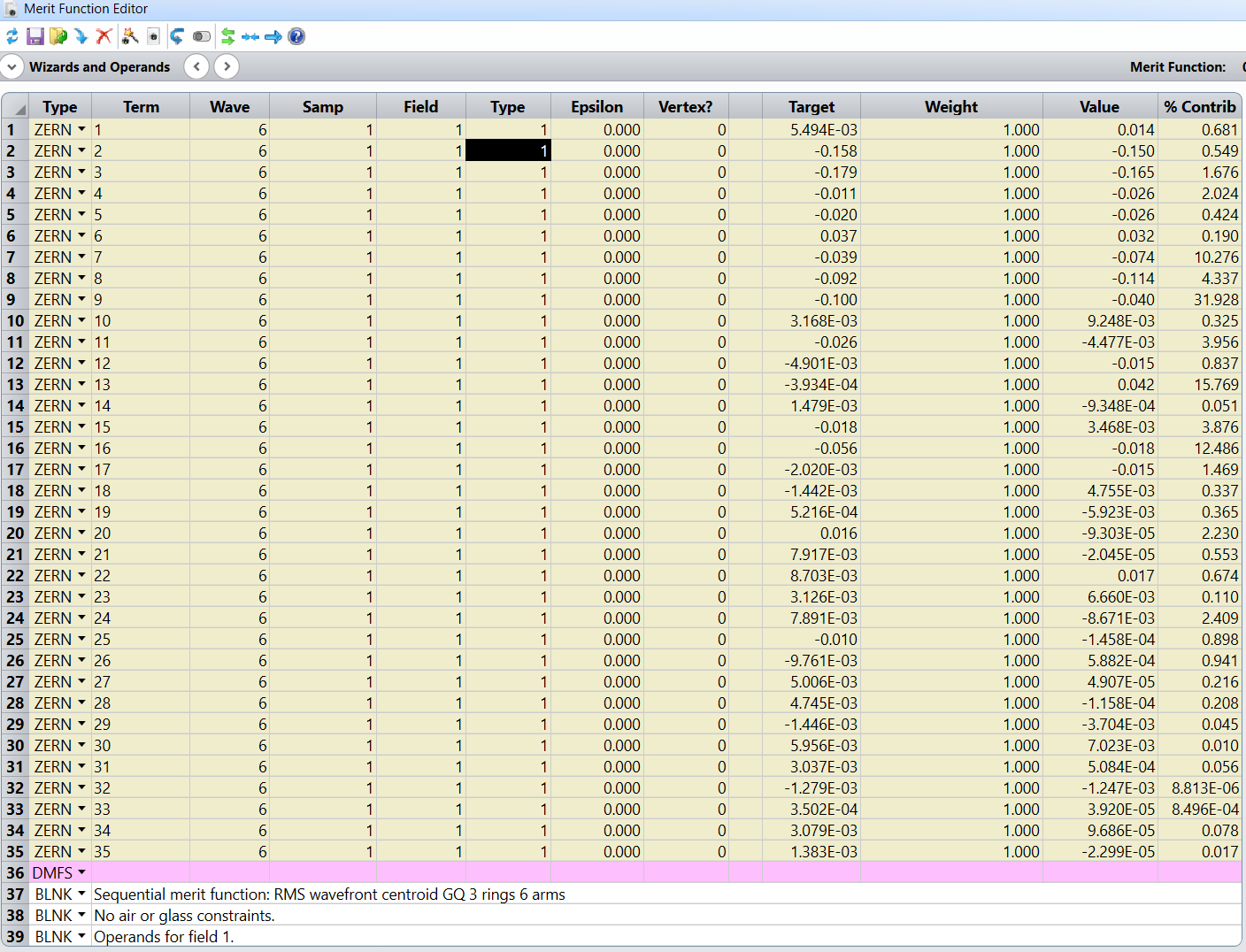
I set up the Zernike polynomial operands with the wavelength and other settings. Use the values of the different Zernike coefficients that I want to reach as “targets” in the editor but when running the optimization, I am far off from the values where I want to be. Am I making a mistake in setting up the operands? Or am I underestimating the complexity of what I want to do, and it will not be feasible?
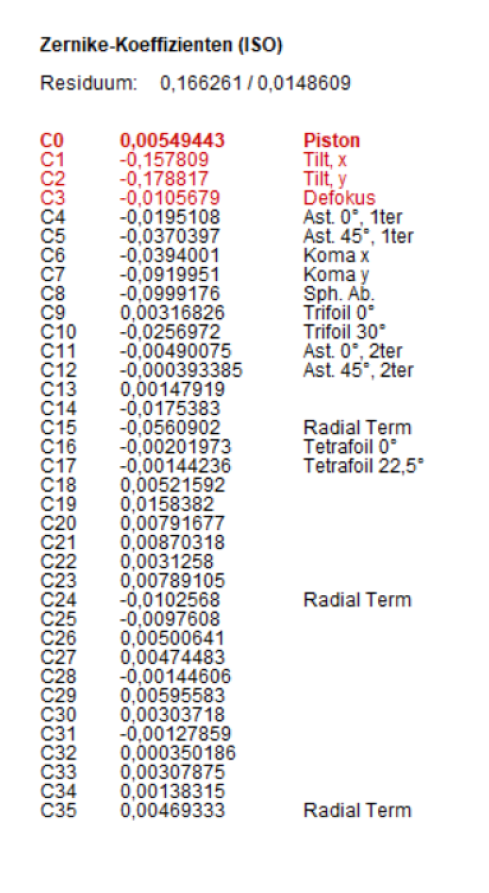
Measured values
Merit function editor setup
​​​​

Has anyone performed such an analysis before? 

Thanks in advance for your inputs.


Best regards,

Amit 



2 replies

Julien.Sauvet
Forum|alt.badge.img
  • Single Emitter
  • April 1, 2026

You may want to import rather your Zernike measurements into a Zernike fringe phase surface located at STOP position, then optimizing your decenter/tilt parameters, so to get low RMS wavefront error.That may work better


Forum|alt.badge.img
  • Fully Spectral
  • April 1, 2026

Your table of measured coefficients does not give the normalization radius for the polynomials. Check with your supplier what this value is if you don’t have it already. There are cases where a smaller inaccuracy (1%) can result is a completely different value even for low degrees coefficients so guessing/handwaving is not good enough.
See for example the article below where the authors found that

“In our example we obtain a relative sensitivity [...] of 11, indicating that the NA value should be specified to 10−3 accuracy when the required coefficient accuracy is 1%.”

https://www.spiedigitallibrary.org/journals/Journal-of-MicroNanolithography-MEMS-and-MOEMS/volume-5/issue-3/030501/Concise-formula-for-the-Zernike-coefficients-of-scaled-pupils/10.1117/1.2345672.pdf

Example using the Zemax doublet sample file, comparing wavefront Zernike standard coefficients for the EPD of 20mm (default) and 19.8 (1% difference). The coefficients are totally different (piston and defocus ~doubled, primary spherical went from negative to positive and the magnitude got 36 times higher.

The use of a Zernike fringe phase surface suggested above likely helps to reduce this sensitivity.