
Question

TEZI composite surfaces use multiple times for same surface

  • October 8, 2026
  • 1 reply
  • 40 views

Hi all,


I am currently doing some tolerance analysis and would like to use TEZI multiple times for the same surface to model surface form deviations of different order. My tolerance data editor looks for instance as follows (just random numbers):
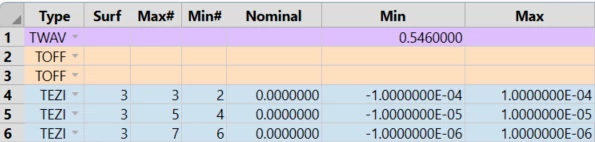
 

The surface that is created looks as follows:

 

It looks like as if the first TEZI is used to change the surface itself to “Zernike Standard Type” and add some values. The second TEZI deletes the surface form deviation of the first TEZI again and adds a composite infront of the surface (no #3). The third TEZI changes the maximum term of this composite but doesn’t add anything. Using TSDR in addition doesn’t make it better.


I am confused. Is it not intended to work as described? At least AI says that should work, even if I can’t find anything in the manual. ;)


My complicated workaround is to add the composites manually before the analyzation and change them accordingly. However, thats quite cumbersome. 


Thank you and best regards,


Gregor

1 reply

Sebastien G.

Hello,

according to the documentation, presuming the surface is a standard one at first, “if the surface is a Standard, Even Aspheric, or Toroidal surface, the surface is converted to a Zernike Standard Sag”.

So first TEZI will effectively change the surface type to Zernike Standard Sag, and the the second TEZI operand will be of a composite type “For all other surface types, the sensitivity analysis will be performed through addition of a Zernike Standard Sag Composite Add-on surface on top of the surface being toleranced.”


So far it behaves as expected in the documentation. However, it is not described as how it is handle if you apply other TEZI operands after that.

I worked recently with the ISOC operand recently, and it is specified that the last operand applied will overwrite other previous operands parameters, only the last one is kept. It seems to behave the same way here.


Using ZOS-API could also be a workaround to manage it the way you want: https://optics.ansys.com/hc/en-us/articles/42661843967635-Modeling-Rotationally-Symmetric-Irregularity-RSI-with-the-API