
Question

Source Diffractive or Physical Optics?

  • Apr 13, 2025 6:37 PM UTC
  • 6 replies
  • 243 views

Leon

I intend to model the diffractions of some structures more complex than a double-slit. One option is using non-sequential mode Source Diffractive, I can directly build these structures. Another option is using Physical Optics, I need insert a non-sequential component with all these these structures in it.

Which is better??? Thank you for help.

6 replies

Leon
  • Author
  • Infrared
  • Apr 13, 2025 10:54 PM UTC


Leon
  • Author
  • Infrared
  • Apr 14, 2025 12:25 AM UTC

It appears that Physical Optics completely neglects what in the non-sequential component and therefore cannot model the diffraction caused by the structure inside the non-sequential component. Am I right?


Leon
  • Author
  • Infrared
  • Apr 14, 2025 11:08 AM UTC

Grok confirms that POP will ignor any non-sequential component


Forum|alt.badge.img
  • Fully Spectral
  • Apr 15, 2025 10:22 AM UTC

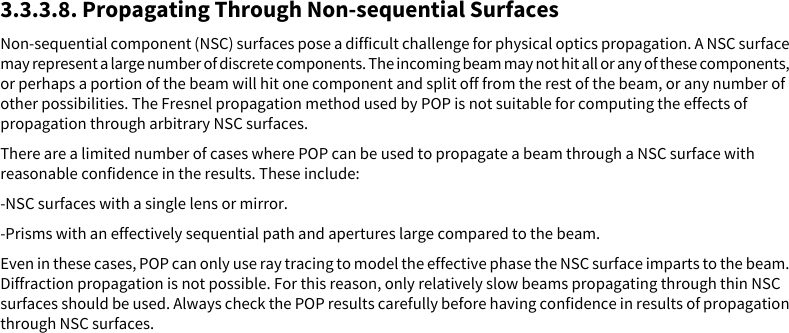
There are some limited cases where you case use non sequential components in POP, according to the manual:

It does not look to me like the even the double slit would work.
Perhaps the Slide (sequential surface) could do it?
Another way could be with apertures, similar to the Zemax example for Fresnel Zone PLate
"\Zemax\Samples\Physical Optics\Fresnel Zone Plate Lens.ZMX"


Forum|alt.badge.img
  • Fully Spectral
  • Apr 15, 2025 11:49 AM UTC

You may also want to look at the “Talbot Imaging “sample from the same folder, where there is a single surface an a more complex aperture.


Leon
  • Author
  • Infrared
  • Apr 16, 2025 2:51 PM UTC

Thank you Ray for the reply.