
Solved

Quantum Yield simulation and definition

  • November 28, 2024
  • 1 reply
  • 134 views

Dear all,

I have a question regarding the Quantum Yield when used in the Phosphors and Fluorescence Volume Physics section in the non-sequential mode.

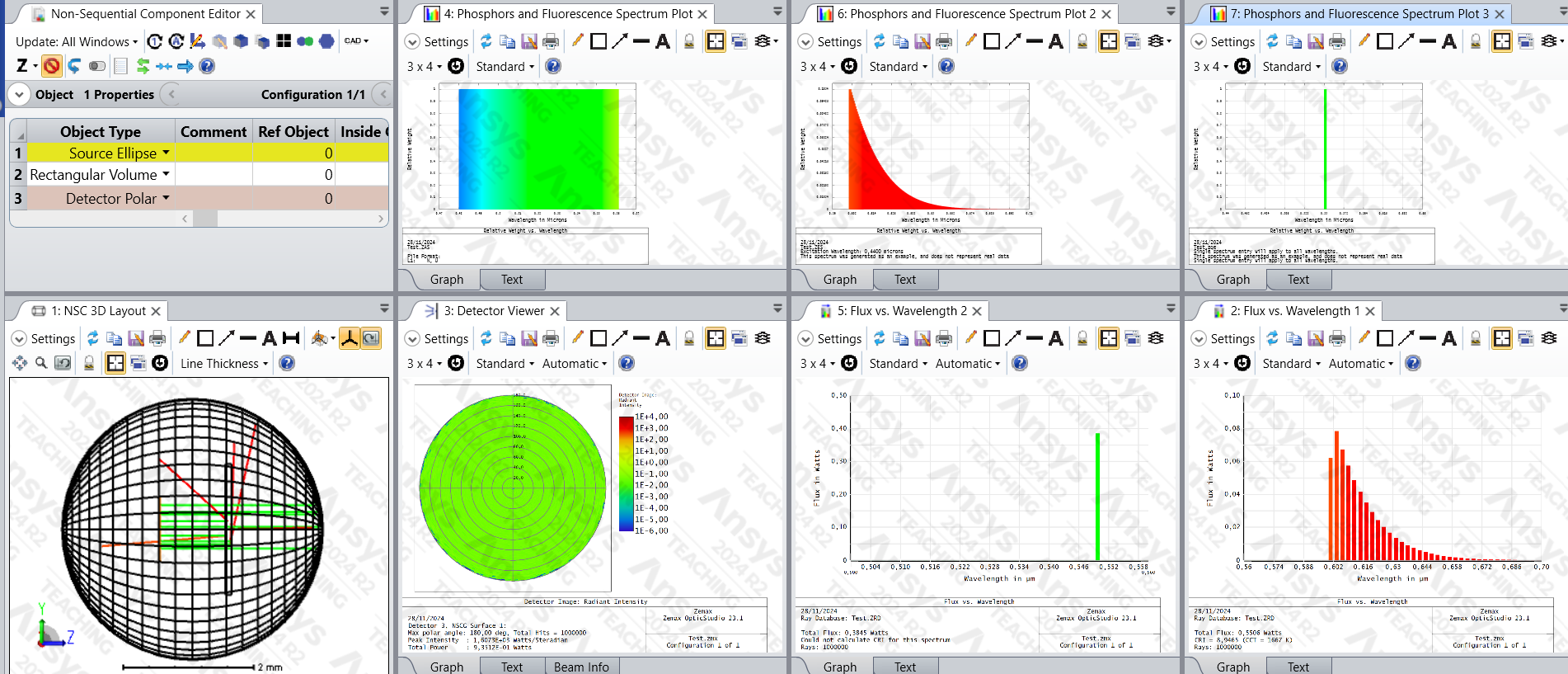
I have a simple setup in Zemax (file in attachment) where I want to replicate a fluorescence quantum yield measurement. It consists of a collimated monochromatic excitation source, a rectangular volume with the volume physics set, and a polar detector capturing all the scattered and fluorescent light. The absorption spectrum is flat at the excitation wavelength (550 nm), the emission spectrum is an arbitrary curve around 600-700 nm, and the quantum yield spectrum is a single value of 1. I have chosen the extinction coefficient such that around 60% of the light is absorbed/re-emitted and the rest is transmitted normally.

With this setup, I would have expected that no light would be lost. However, looking at the total power captured by the polar detector, only 93% of the light remains. Looking at the flux vs wavelength plots shows that we have ~38% of the light at the excitation wavelength and ~55% at the emission wavelengths. 
 

My guess is that the intensity of the fluorescent light is reduced by this ‘Stokes shift’ factor as explained in the documentation:
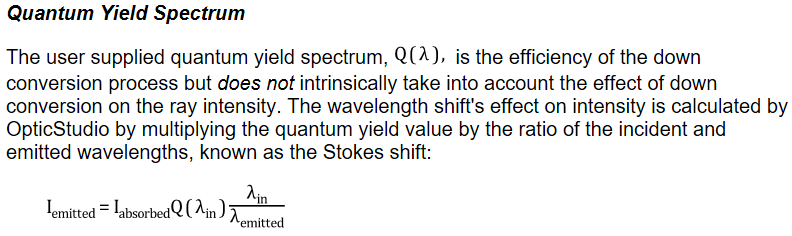
  • Is this indeed the case, or is the reduced power coming from somewhere else?
  • If it is the case, what is the reason of including this ratio in this calculation?


I would be glad if someone could help me understand this issue better.

Thanks,

Best regards,

Indy

Best answer by Indy.Magnus

Solved: although the number of photons are not reduced (see also number of hits on the polar detector), the total energy (and thus also power) is reduced since part of the photons are re-emitted at longer wavelengths and thus at lower energy. This is exactly what the Stokes shift factor is doing. Converting the optical flux values back to the number of photons at each of the wavelengths (dividing by the photon energy hc/l) we have 0.55e-9/hc photons/s of the excitation source, and 0.212e-9/hc + 0.0367e-9/hc + 0.0470e-9/hc + … + 0.0000258e-9/hc = 0.55e-9 photons/s collected by the polar detector, so indeed no losses are found. Quantum efficiency is defined by the number of photons emitted divided by the number of photons absorbed, so a re-conversion from flux to photons is always required. Calculating this we have 0.34e-9/hc photons/s absorbed and 0.34e-9/hc photons/s emitted, so indeed a quantum efficiency of 1.

1 reply

  • Author
  • Monochrome
  • Answer
  • February 25, 2026

Solved: although the number of photons are not reduced (see also number of hits on the polar detector), the total energy (and thus also power) is reduced since part of the photons are re-emitted at longer wavelengths and thus at lower energy. This is exactly what the Stokes shift factor is doing. Converting the optical flux values back to the number of photons at each of the wavelengths (dividing by the photon energy hc/l) we have 0.55e-9/hc photons/s of the excitation source, and 0.212e-9/hc + 0.0367e-9/hc + 0.0470e-9/hc + … + 0.0000258e-9/hc = 0.55e-9 photons/s collected by the polar detector, so indeed no losses are found. Quantum efficiency is defined by the number of photons emitted divided by the number of photons absorbed, so a re-conversion from flux to photons is always required. Calculating this we have 0.34e-9/hc photons/s absorbed and 0.34e-9/hc photons/s emitted, so indeed a quantum efficiency of 1.