
ISOC tolerance operand

  • July 31, 2026
  • 3 replies
  • 73 views

Sebastien G.

Hello everyone,


I was working on tolerancing a new design and comparing “old method” TFRN+ TIRR, to the ‘new method’ ISOA/ISOB/ISOC, and it seemed to me that the new method was more ‘pessimistic’ that the old one.


Looking in details to compare the methods, I made a very simple system (1 PCX lens, R=50mm, N-BK7, Aperture 10mm) and compared different combinations :

  • ISOC alone
  • TIRR + ISOC
  • ISOB + ISOC

Looking at the results I stumbled upon the fact that the contribution in sensitivty of ISOC was not the same depending of the associated operand :

ISOC alone : ISOC       2                 -0,50000000         0,00399992         0,00215149         0,50000000         0,00399992         0,00215149

TIRR + ISOC : ISOC       2                 -0,50000000         0,00399992         0,00215149         0,50000000         0,00399992         0,00215149

ISOB+ISOC : ISOC       2                 -0,45000000         0,00790629         0,00605786         0,45000000         0,00790629         0,00605786

(Here I reduced the value to 0.45 to be compatible with ISOB)


The two first methods give similar result, which is correct to me as in sensitivity mode, only this operand is applied to the surface, and with the same amplitude, one get the same impact on performances.

But it is not the case with ISOB+ISOC, with a ratio of around 3, which bothers me.


Does anyone have some explanation ?


I am with OpticsStudio Pro 2026R1.

3 replies

Jeff.Wilde
Luminary
Forum|alt.badge.img+3
  • Luminary
  • August 29, 2026

​Hi ​@Sebastien G. 

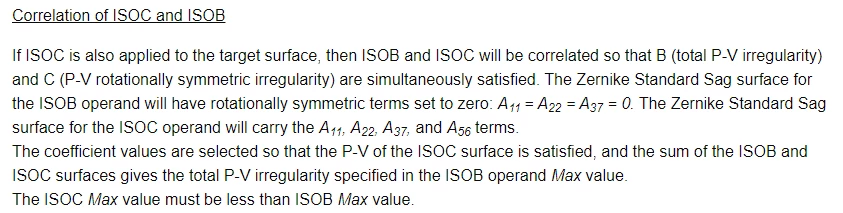
I think the reason you are seeing different sensitivity results for ISOC (depending on whether or not ISOB is also used) has to do with the correlation between ISOB and ISOC.  As noted in the help documentation:

This means the Zernike coefficients used for ISOC during tolerancing will be different if ISOB is also included in the tolerance listing (prior to ISOC).  You can use a SAVE operand in the TDE to see the details.  Lastly, note that the order matters.  I observe a difference if ISOB comes before, compared to after, the ISOC operand.  

Regards,

Jeff


Sebastien G.
  • Author
  • Infrared
  • August 31, 2026

Hello Jeff,

thank you for your feedback, and you are right the order of the operands do change the result, and one must specify ISOC before ISOB on one surface.

In my understanding, ISOC is applied and then ISOB is calculated to fit ISOB Max value, so ISOC contribution should not change wether it is employed alone or with ISOB.

In the meantime, I have been in contact with the support of my Ansys partner (which was in contact with the Ansys support), and this behavior does not seem to be expected anymore and/or documentation does not reflect correctly the current usage.

There have been changes in the documentation between the 2024R2 and the 2026R1 concerning these operands (see attached screenshots), as the mention of this particular order of the operands disappeared and having multiple ISOC applied to one surface should not trigger an error message anymore, but only the last operand value will be applied.

A bug report has been opened for this issue.

I will use the correct order from now and wait for any update.

Regards.

Sébastien


Jeff.Wilde
Luminary
Forum|alt.badge.img+3
  • Luminary
  • August 31, 2026

Thanks Sebastian.  Yes, it appears that a fix is needed.