
Question

Difficulties while balancing CRA, Distortion and MTF

  • June 16, 2026
  • 8 replies
  • 66 views

Thaniga

Hi All,

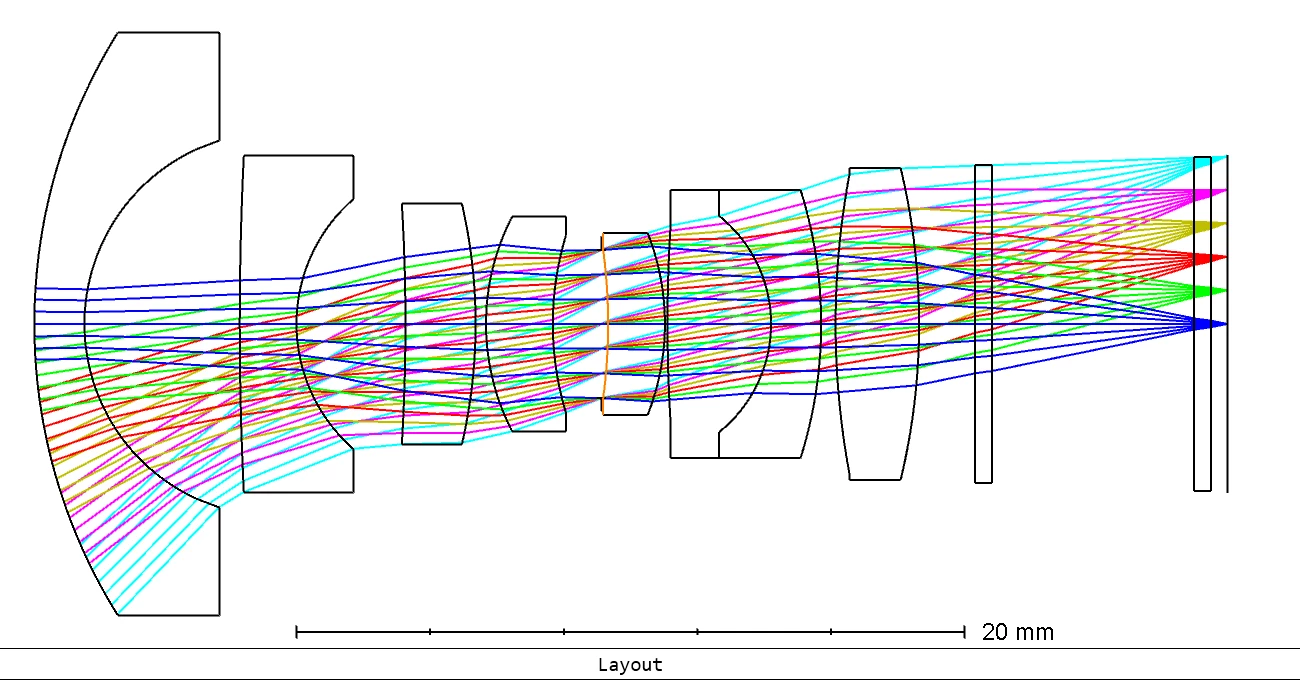
I am currently designing a low‑cost imaging lens for a sports application. In my lens model I use the REAY operand to control image height, the RAID operand to control chief‑ray angle (CRA), DIMX to control f‑theta distortion, LACL for lateral‑color correction, RSCH for spot size and MTFT/MTFS for resolution across the field. During optimization I can obtain either good MTF or good lateral color with CRA and distortion depending on the operand weightings, but I cannot find a stable balance even when I adjust the weights gradually. In both cases, my geometric spot‑size results were poor. Please suggest optimization techniques to achieve a better trade‑off, or alternative approaches to indirectly control these parameters.

Note: candidate glass materials must have hardness greater than 450.


Thank you in advance for your support.

8 replies

Forum|alt.badge.img
  • Fully Spectral
  • June 16, 2026

Hi Thaniga,


Can you please share your zemax file?

It will be easier to help that way.


Thanks,

Nadav


Thaniga
  • Author
  • Infrared
  • June 16, 2026

Hi Nadav,

Thank you for your immediate response. Apologies, I do not have permission to share the zemax file in the forum. Hope you understand. Please guide me to get the result by direct/ indirect optimization technique. Also, suggest me how to pick the low cost high hardness material in granta material picker.


Thank you for your support.


Forum|alt.badge.img
  • Fully Spectral
  • June 16, 2026

Ok. understood. Can you share image of the system and the ray tracing? without knowlege of the system it will be hard to help


Thaniga
  • Author
  • Infrared
  • June 16, 2026


Forum|alt.badge.img
  • Fully Spectral
  • June 17, 2026

Hi Thaniga,

We will need to know more about the systmem: Field of view, stop size, effl, total length etc. Also the required prefromance. Without, it will be very hard to help. Did you try wavefront or contrast optimization?

And regarding the hardness, you can make a catalog with Hoya glasses(hoya hardness glass table-first result google), use GCOS operand to control the price and then use hammer optimization with glass substitution.

B.R

Nadav


B.R

Nadav


Thaniga
  • Author
  • Infrared
  • June 18, 2026

Hi Nadav,

Thank you for your continued support. Basic requirements: DFOV 110°; F-number 2.2–2.4; TTL < 38 mm; wavelength range 430–650 nm; maximum image circle 10.2 mm; front lens diameter < 22 mm (including mechanical housing); lateral color < 4 µm; chief ray angle (CRA) < 12°. I evaluated the design using contrast optimization with weighted improve manufacturing yield.

Thank you once again for your support.


Forum|alt.badge.img
  • Fully Spectral
  • June 18, 2026

Hi,


Thanks for the input. We also need any other constraint like: Detector size, stop size(looks like 6-8 mm right?), maximum weight, no of lens etc. can you please share your mtf graph?


Thanks,

Nadav


Forum|alt.badge.img+2

Dear Thaniga, 
It's very difficult to advise remotely without access to the file. But here are a few remarks and suggestions I can offer:

- In your specifications, you don't mention axial chromatic aberration, only lateral! Why?

- LACL is a paraxial operand, which is therefore of little use since, in your case, the field of view and aperture are large.

- You say "lateral chromatic aberration < 4 µm," but what will your pixel size be?

- I don't understand why you're using RSCH. If you optimize with the "spot" method, you reduce transverse aberrations and therefore the size of the image spot.

- Optimizing on the MTF is a bad idea. It significantly increases the optimization load, making it less efficient.

- What I would do:
* Have few operands in the MFE. Rather than hoping Zmax will do the work on its own (it won't), try to assist the optimizer. We are incredibly fortunate to have a brain, and we must use it!

* Assess the geometric and chromatic aberrations and tackle the most significant ones. In general, Zemax corrects geometric aberrations quite well. However, chromatic aberrations are more difficult to correct. A Hammer optimization could help, except that in your case, you have 8 lenses. You will be faster by manually changing the materials and relying on theory.

Could you show us the "chromatic focal shift" curve and the "ray aberrations" curves at the maximum field of view?

I hope this will be useful to you

Regards, 

Thierry Lépine.